Saturday, March 28, 2009

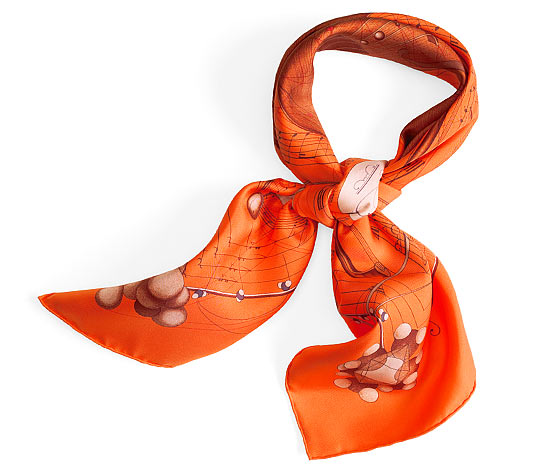
Collection FW2008: Dancing Pearls

Virginie Jamin, who has created a name for herself with such wildly popular designs as "Belles du Mexique", dreamt up a story of a woman who leaves India on a boat without suitcases or memories. All she carries with her is a light, sparkling necklace of Indian pearls. Swayed by the tumultuous waves, she starts spinning in circles in a sort of hypnotic dance. Her necklace twirls in time and appears to be actively participating in this unique choreography.


The movement of the pearls draws her into an intoxicating whirlwind. The necklace that offered her the most beautiful dance of her life comes undone at one end, sending the pearls rolling, spreading loose, being engulfed by the sea. All that remains of this magical moment is a single pearl, which she wears every day, because it brings her a peaceful sense of happiness.


The design instills a surprising sensation of movement. The pattern is pretty busy; yet, I consider that the scarf should be worn so as to display in a bigger proportion than others the pattern, to communicate its message clearly. A headscarf would be a wonderful fantasist manner.

Saturday, March 21, 2009

Collection FW2008: Coupons Indiens


This scarf, designed by Aline Honore and issued in 2009 as part of Hermes' Indian theme, pays tribute to the infinite creativity in textiles - in terms of fabrics, patterns and colours. One of the many riches of India, fabrics - whether cotton or silk - come in a variety of styles: simple, ornate, printed, woven, embroidered and sequined and in countless imaginative patterns: floral, folk, geometric, abstract ..... "Coupons indiens", carrying us to a fabric strand at an Indian marketplace, lends the fabrics a tactile feel suggesting fluidity and suppleness.

Coupons indiens is a hymn to the colour, with its numerous tints - all produced from natural pigments. Colour is everywhere in India, vibrating with strength, brightness and a rich palette. It illuminates women's diaphanous, elegantly draped saris. It crowns men with dazzling turbans. Its symbolism adds a certain rhythm to life: red for joy, yellow for its promise of happiness, the sheer serenity of pure white.

With so many designs and colours, which one would you choose?

This scarf ties wonderfully, as the richness of the design instills a natural sophistication to the person who wears it. Perhaps even more impactful is the larger size variation of this scarf, in cashmere and silk, which allows the wearer to wrap it around the neck while the edges display, in all their splendour, the richness of the pattern. A true visual celebration, the scarf's vibrating character transcends the fabric to define the wearer beautifully !

Saturday, March 14, 2009

Collection SS2007: Vif Argent

An interesting design by Dimitri Rybaltchenko, "Vif Argent" ("Quicksilver") depicts drops of mercury that form, by way of continuous lines, the famous Hermes brand. It is a stirring design, beautiful in its simplicity, but one that does not have a particular impact when knotted traditionally around the neck - unless a good part of the middle design is displayed, as in a headscarf fashion, or perhaps in a knot where a good quarter of the scarf is displayed in front.

Saturday, March 7, 2009

Collection FW2008: Tohu Bohu


In French, "Tohu Bohu" means tumult, commotion, so "Hurly Burly" would be an appropriate translation. This scarf, first released in 2004 and reissued in 2008 and again in 2010 on cashmere/silk, features concentric circles, each of a different colour, starting in the middle of the scarf and increasing in size until the largest circle becomes inscribed within the scarf. Within the widths of select circles are inscribed, one per circle, the letters that make up "Hermes". Each of the corners depicts one element of the address of the Maison's Faubourg St.-Honore flagship boutique - "24", "Fbg", "Paris" and "France", each word having its letters in disorder (the other definition of "tohu bohu"). Finally, the very edge of the scarf features the many colours that have been already included in the design, in a sequence, similar to that of the Human DNA, that's harmoniously playful and adds the extra element of surprise and "fun" when the scarf is worn.

The design was created by Claudia Stuhlhofer Mayr, a very successful designer - and the only Austrian designer in the art team of Hermes for twelve years.

This pattern was an instant success with fans of Hermes, including the most renowned Italian singer of all times, the late Luciano Pavarotti (seen here wearing the orange GM version - "grand modele", or "large size-XL" - in cashmere/silk blend).

In response to such popularity, Hermes has further satisfied the public's thirst by adapting this design for jewelry and household items such as porcelain, themselves very popular items and sought-after collectibles.

Saturday, February 28, 2009

Collection FW2007: Faubourg by Night

This design has been issued in 2007/2008 and remains one of Hermes' most impactful abstract designs. It depicts the Maison's iconic building at 24, Faubourg as perceived through a kaleidoscope.

The kaleidoscope, invented around 1816 by the Scottish physicist, mathematician, astronomer, inventor and writer Sir David Brewster, is a tube of mirrors containing loose coloured beads, pebbles or shards, which produces, when turned, varying colours and patterns; because of the mirrors, the reflection of such arbitrary designs produces beautiful symmetrical patterns, something that I used to cherish as my secret treasure whenever my grandparents would buy me one, typically when we were vacationing on the Black Sea (the name kaleidoscope derives from the Greek "kalos" (beautiful), "eidos" (shape) and "scopeo" (to look at, to examine) - hence it would be roughly translated as "looking at beautiful forms").

Faubourg by night depicts the iconic building as an elusive shape, covered under the night's dark skies, yet the image reminds us of the intrinsic beauty of this place. It even stirs our imagination and our curiosity to discover it. A truly gorgeous design the ties beautifully and is guaranteed to elicit the admiration of any audience.

Saturday, February 21, 2009

Collection SS2006: Plaza de Toros


An earlier design that's as simple as it is stirring. The bullfighting, one of Hubert de Watrigant's favourite themes, brings dynamism and a certain adrenaline rush to the scarf (and particularly to both admirers and those who sport it). The raw and primal fighting for survival, coupled with the stage "dance" and bullfighters' harmonious movements make the "Plaza de Toros" a sensual enough scarf to be sported by ladies and masculine enough for men. Of all the scarves illustrated here (including those in my collection), I would definitely consider wearing this one !

Saturday, February 14, 2009

Collection SS2007: Etriers


This post continues the tradition of depicting scarves that pay tribute to distinguished craftsmanship, artistic sensibilities and vision. More, the colour combination of this particular scarf is also a discreet yet impactful homage to the House of Hermes (with its distinct and emblematic orange as the predominant colour of this scarf).

Emile-Maurice Hermes (18 December 1871 - 11 September 1951), the grandson of a founder of saddle and harness manufacture in the Grands Boulevards district in 1937, is said to have acquired an unusual switch attached to an umbrella from an antique dealer at the tender age of 12. This is how the legend of the collector "par excellence" was born. Throughout his rich life, Emile built an impressive archive of items which he categorized into various collections, including a true "Museum" of equine transport, from which this design drew its inspiration.

First launched in 1964, this scarf has been met with enthusiasm by Hermes' loyal customers and admirers alike, and has been reissued in 1990, 1997, 1999 and again in 2009 (the picture is part of the latest reissue). The scarf depicts various stirrups that, as with many other creations, have evolved over time from strictly utilitarian objects to articles of art and tremendous craftsmanship, intended to garnish the feet of male and female gentry riders, around the world. A side-step saddle stirrup from South America (19th century) is depicted alongside a silver-finished wooden stirrups from Peru (18th century), a pair made of brass from the Middle East and a copper pair from France and Spain (end of the 18th century). Their variety, inventive beauty of detail and ingenuity are a testament to the craftsmen who continue to place their know-how and talents to the service of the noble equestrian art.

May we all find inspiration in the experiences we create and people and things we come across, find the courage to turn that inspiration into wonderful outcomes, and continue to inspire those around us.

Saturday, February 7, 2009

Collection FW2007: In the Pocket


Another variation on the theme of "In the Pocket" is this truly phenomenal scarf, depicting an outstanding taupe background. The little objects that are forgotten in corners of our pockets - coins, paper clips, buttons, the corner of a newspaper, an elastic - are active story tellers, their murmur bringing our experiences past back to life. A remarkably distinguished and exceptionally elegant colour that renders this design one as of the most exquisite scarves ever produced. The designer, the very talented Leigh P. Cooke.

Saturday, January 31, 2009

Collection FW2008: Fantaisie Pittoresque


The Winter has begun, and to take our minds off the snow and the cold, I thought I'd tap into the 2008 Fall/Winter collection (which I haven't explored yet) to feature a fantastic universe that I used to imagine as a child, by the fireplace in the countryside, when my grandfather told me stories to make the time flow quicker, and to put me to bed - fantastic stories which I believed wholeheartedly.

With this scarf, the artist, engraver and landscape architect who worked on Leila Menchari's window displays sweeps us away into a world of 18th century gardens. In these gardens - reminiscent of the "Desert de Retz" in Chambourcy, the "Bagatelle" Gardens in the "Bois de Boulogne", the "Monceau" Gardens in Paris and the "Kew and Stowe" Gardens in Great Britain - plants (whether untended or highly manicured) serve as a showcase for architectural delights including "follies" - or sophisticated - ornamental pavilions, "ancient ruins", columns, temples, arbours, grottos or arches.

In the spirit of a mysterious, fairy-tale forest filled with fantasy, "Fantaisie Pittoresque" overflows with lush, green plants. Leaf festoons and intertwining roots outline individual rooms brimming with vegetation; a series of peaceful, timeless places without the slightest trace of human intervention. An immense sense of peace and a very unique silence reign over all. With this scarf, the artist extends an invitation to stroll through his imaginary garden, to fall deep into thought and to dream - in order to reconnect with the elements, with the world of plants and minerals.

I find this design very traditional, appealing to someone with a taste for more classic creations, and the sepia colour of this design is lovely.

Saturday, January 24, 2009

Collection FW2005: Les sources de la Vie

"Les sources de la vie" ("Sources of life") is an appropriate name for the scarf that pays tribute to the impact that water has on the humanity and its prosperity.

This scarf was designed by Fred Rawyler and issued as part of the Maison's Fall/Winter 2005 collection, dedicated to the "water" theme.  It is a very simple concept - it lists the names of some of the largest rivers in the world followed by the countries these rivers cross and their lengths, in a long series that snails around, starting in the center of the scarf and working its way outwards, like a river that carves its way into the ground until it finds another body of water to join. While I don't find the actual pattern particularly appealing, I do find the theme and the concept quite innovative - hence my desire to mention it in this Costinianus "hall of fame".

Saturday, January 17, 2009

Collection FW2007: Jardins d'Hiver

This Christmas I received the most unexpected gift: a visit from a very dear friend of mine, from France, who was en route to New York via Toronto when many US-bound flights were grounded due to safety and security concerns in the air. So seeing him, after so many years, and indulging him in tourist activities was like a garden that blossoms following a long process of cultivation. "Jardins d'hiver" (winter gardens") captures beautiful this feeling, depicting seven gardens around the world that enchant the visitor with sights, aromas and sounds, reminding us of the majesty and beauty of nature. Created by Annie Faivre as issued in 2007/2008, this scarf illustrates artistic compositions with details from seven distinct gardens: the mythical Hanging Gardens of Babylon, a medieval labyrinth of topiaries, the gardens of the Villa Borghese in Rome, the Majorelle in Marrakesh; the Alhambra in Grenada (Spain), the Taj Mahal gardens and finally the Heian Garden in Kyoto.

It is a very gracious scarf that wears absolutely beautifully, and when it evoques such strong sentiments, it has an even stronger impact.

Saturday, January 10, 2009

Collection FW2007: Fleurs d'hiver


Today I woke up to a snow-covered city (or at least neighbourhood) and I remembered how pretty - pure, immaculate and simply beautiful - the snow makes everything appear, covering all the dirt and giving one the illusion that everything is indeed pure. Today's post marks the beginning of a series of scarves dedicated to the season and holiday spirit. I took a liking to this scarf a while back, and while I never played with the scarf itself, it never ceases to exude a fairy-tale feeling; in addition, it ties beautifully and would make a fabulous accessory for those who believe in discreet impact. The name - "fleurs d'hiver" ("winter flowers") suggests the delicate flower-like shapes of snow flakes. The pattern is pretty geometric - suggestive of the science behind the perfect appearance of snow flakes, adorned with rain-deer, flowers and naturally snow flakes.

This particular colour design is interesting for the brown hues it uses, although the black border is too severe for me and definitely tones down the uplifting induced by the theme or season. There is, however, a palpable harmony in this design that really caught my eye. Perhaps a little tradition due to its geometric sequences, but definitely wonderful.

Saturday, January 3, 2009

Collection SS2004: Cheval Surprise


In keeping with the holiday spirit, I thought it wise to start the year with a scarf that echoes the wonderful display of fireworks that celebrate an accomplishment or mark new beginnings.

I took note of this scarf when it was first released, several years back, without understanding the significance of its title, or the intrinsic message of the design. Since I channeled my passion for scarves and my energy to understand and share the beauty of each, I paid closer attention to this scarf and realized how fascinating the design actually is. On closer inspection the ink-blot design, remiscent of Jackson Pollock's creations, reveals horses, horseback riders, carriages and drivers - each one in a dynamic pose (check each corner, plus the areas between them). The author is the very talented Dimitri Rybaltchenko, the son of another designer in the service of Hermes, Vladimir Rybaltchenko (who is connected by marriage to yet another one of Hermes famous designers, Phillipe Ledoux).

A true visual feast, which I'm only too happy to have added to my modest collection (in the gavroche size), thanks to a kind and sensible person in my favourite country, Japan, who since became a close friend. Thank you MF-san !

So here's to the hope a new year brings and to new beginnings !!

Thursday, December 25, 2008

Collection FW2004: Noel au 24 Faubourg

An all-time classic, "Noel au 24 Faubourg" ("Christmas at 24, Faubourg") depicts the Maison's Paris flagship boutique at No. 24 in an apparent snow globe (with the accompanying snowflakes peacefully making their way onto the ground). The globe is surrounded by snow-covered pin tree branches. Of amazement are the ornaments on these branches, in the shape of elves in different poses, some playful, some enjoying winter sports. The ubiquitous - and emblematic - "bolduc" (a thin ribbon or thread, now associated with "gift ribbon") adds a discreet touch while its curls further enhance the spirit of celebration and playfulness - and evoking magical childhood memories.

This design, created by Dimitri Rybaltchenko in Fall/Winter 2004 and reissued in Fall/Winter 2006 in 45cm pochette and 90cm cashmere/silk, has been highly popular and a sought-after collectible.

Saturday, December 20, 2008

Collection FW2006: La Musique des Sphères


A design that triggered a tremendous emotional reaction is "La Musique des sphères" ("the music of spheres"). I love music, and while I'm not a particularly keen fan of the violin sound, I adore the actual instrument, with its delicate and gracious lines - a true personification of femininity and beauty !

An apparent ode to music (it is widely reported that Bach's inspiration for his music was drawn from the harmony of the universe), this scarf pays tribute to the popular belief that music and mathematics share both grace and harmony - hence the mathematical symbols - the water's molecular structure (represented by the circles) and the representation of the Pythagorean theory.  The focal point of the design is the rendition of the exquisite "Viola di Medici", produced by Antonio Stradivari in 1690.  The exquisite beauty of this violin (captured vividly and with accuracy on this scarf) makes all those beliefs very credible !

The interesting aspect is that when the scarf is knotted, the enchanting effect is somewhat lost, as the scarf does not convey the same emotion, mainly due to its many lines suggestive of geometric shapes, including the spheres in every corner, which carries one's imagination to a certain intergalactic journey (or perhaps the mollecules inside the human body). While theoretically linked by way of a certain belief that music lifts spirits to heaven, the two concepts - violin and intergalactic journey - do not seem to coexist harmoniously on a scarf, especially when worn.
This year, Hermes has released a limited edition scarf with identical design but under a different name - Tribute to Carnegie Hall - and available exclusively in the Madison Avenue boutique. The colour ranges for the 2009 edition are violet and orange only !

Saturday, December 13, 2008

Collection SS2000: Chaque Rencontre Est Unique


I came across this design from 2000 and was captivated instantly by its beauty, simplicity, exquisite details, symbolism and its ability to capture - and express - the individuality of the Japanese spirit.

"Every Meeting is Unique" is a tribute to the people, animals and to a certain extent, the things that we come across. The upper and lower sides of the scarf depict a meeting, possibly between two individuals, possibly between four. Of equal interest are the pairs of cranes, symbolic of Japan, that are united through a magic dance and whose shapes (another allusion to the Japanese art of shadow theatre) are graciously reflected opposite them.

The composition is classically "solar", with the focal point drawn in the middle of the scarf from which emanate towards the edges of the scarf, like sun rays, the elements of the design.  This style of drawing has been the foundation of the original Hermes design; the landscape, the Arabesque, have been successfully explored only in the more recent history.
I continue to be mesmerized by the beauty of this scarf, and the rich meaning its title and its design carry.

I dedicate this scarf to all those who have crossed my path in life, indeed, I dedicate this to all my friendships and also those encounters that, despite our wish, had an immediate unexpected effect on us yet which served to teach us powerful lessons for the many years to come.

Saturday, December 6, 2008

Collection FW2007: Cheval de Caractère


Soon I'll celebrate my birthday, and so it's only natural that I speak of scarf that depicts a remarkable animal, admired and respected the world over, whose relationship with the human being has flourished over the years, yet now is to be found in only a handful of places (such as the countryside): the noble horse!

The image of the horse in "Cheval de caractère" ("Horse of Character" - the title bears a double entendre, as "character" in French refers to printed letters) is rendered by the shapes and shades of the five letters that make up "Hermes".  They repeat along lines across the entire scarf.  This particular orange is very vibrant and balances very nicely the more "mature" design. A spectacular sensorial feast.

I find this design particularly impactful for the image it reveals on close inspection (or rather per ensemble, or "from awar") - and thereby likely hidden to the uninitiated eye.  I find it equally elegant for the sophistication of the pattern - no longer individual objects, but a series of letters.

Since I started the blog, I seldom came across instances where this scarf became available for sale - but never in this colour combination, which is a strong testament to it appeal.


Saturday, November 29, 2008

Homage to Japan: Daimyo, Princes du Soleil Levant


Another gem in the Japan-inspired themed scarves, the Daimyo is an impactful yet gracious scarf depicting samurai swords entertwined with the leaf motif (the symbol of Tokyo).


"Daimyo" (from "dai" - "large" - and "myō" - short for myōden, meaning "private land") is a generic term referring to the powerful territorial lords in feudal Japan (the period, also referred to as "premodern", that spans from the 10th century to the early 19th century) who ruled most of the country from their vast, hereditary land holdings; they were the most powerful rulers after the "Shogun" (military rank and historical title for Hereditary Commanders-in-Chief of the Armed Forces of Japan, the equivalent of today's "Generalissimo").


"Soleil Levant" ("Rising Sun") is another name for Japan, something I, too, was fortunate to discover upon living there - the impact is particularly felt during the first days in the country, when my sleeping patterns were off relative to the rhythm of life there and in addition, the birds started chirping outside my window at 4am for the sun was already high up in the sky).


So the title of the scarf "Daimyo, Princes of the Rising Sun" is a gracious name that sets the tone for the entire feel of the scarf: swords, their symbols, are skillfully depicted with various insignia of the powerful lord clans. In the center, the gingko leaves (from a ubiquitous Japanese tree and the symbol of Metropolitan Tokyo) surround two cranes - another symbol of Japan - in a very harmonious circle.
Finally, the regal look of this scarf is also impressed by the jacquard silk, the fabric that has a pattern (also of gingko leaves) weaved in it. This scarf is one of the most beloved Hermes productions, a highly collectible scarf and a sought-after design in any sale or auction around the world, particularly since the material is no longer utilized by Hermes due to the excessive costs of production.

Saturday, November 22, 2008

Collection FW2007: Grand Carrosse pour un Ambassadeur


I was spending my summer in Japan in 2007 when Hermes announced, with great fanfare, the launch of its 70cm carre. Of course the news was received overwhelmingly well and with a great deal of enthusiasm, despite the existing availability of such scarves for many years. The collection is entitled "Vintage" and the scarves display either a vintage appearance, or vintage colours (or both), to endorse the title.

One model that appealed to me was "Grand Carrosse pour un Ambassadeur" ("Great Carriage for an Ambassador"), albeit not in all colours. The golden decorations against the vintage green makes for a very impactful effect, and this is the only colour combination that I found desirable - for my liking, of course.

Saturday, November 15, 2008

Collection SS2006: Les Jardins d'Andalousie


This is the first scarf design that I remember coming across, as a younger adult, and by the time I could afford one, many years later, the actual scarf was no longer available, so needless to say that while I don't possess one (yet?), I still find it splendid and simply spectacular - the richness of the design carries me to the Andalusian hills and the fascination of everything beautiful that Spain has to offer - above all, the vivacious spirit. I love the sensation, felt by the admirer, to be on a patio, likely at the cover of the shade, gazing beyond the supporting columns to admire the landscape - possibly orchards, the surrounding hills and the stream of water.


I also love the fruit - pomegranates and lemons - that bring so much colour and life to the design. Under normal circumstances, I would have considered this pattern too busy, but there's something about it - perhaps the harmony between the apparent fruit basket in contrast with the geometric pattern along the edge (reminiscent of the Maurish architectural influences), or just the colour combination - that makes it very rich, very voluptuous, very passionate.... and so elegant !

A definite statement of absolute sophistication !

Saturday, November 8, 2008

Collection SS2007: Belles du Mexique


One of the most striking designs I have ever come across, "Belles du Mexique" ("the Beauties of Mexico") is yet another ode to the effervescence of the Mexican culture, as so vivaciously expressed by the fiestas.  Indeed, this scarf is a celebration of the serenading music, dynamic dancing, rich display of costumes and of the Mexican people (in here, predominantly women) who feast the eyes of the admirers with their skills and beauty.


A first glance suggests circles lined up along the scarf edges in orderly fashion; yet, on closer inspection, we recognize that every apparent "circle" depicts, in fact, a Mexican dancer's dress, in full swirling motion.  The focal point of the scarf depicts - perhaps - THE most beautiful dancer, surrounded by four Mexican gents serenading her.  


The border is made up of  a geometric pattern that adds a harmonious balance to this otherwise playful and very dynamic design.  The careful use of colours adds dynamism and playfullness as well.  By far one of my most favourite designs, this scarf is a true fiesta for anyone wearing it, traditionally, around the neck, on the shoulders or as a waistband.  You are sure to turn heads !


Saturday, November 1, 2008

Collection FW2006: Fleurs de Fuchsia


I came across this wonderful scarf just by chance, and was immediately taken by the rich background colour, discribed as "brick red". It is intense, without being too bright or over-the-top, and definitely exuding sophisticated elegance. Quite charming ! The pattern, on the other hand, was again very appealing because of the delicate flowers, depicted with their shadows, that give both depth and the impression of real flowers dispersed on the scarf. A testament of definite refinement and elegance both for the designer and for person who'll sport the scarf !

Saturday, October 25, 2008

Collection FW2008: Attrapes tes rèves


Native Americans believe that dreams, good and bad, travel through the room, in the silence of the night, before they reach those who sleep. So a round web-like creation (bound with thin leather stripes and hung above the bed) can attract and "catch" the bad dreams and nightmares, leaving the good ones "unaffected" to reach the dreamer.

This scarf, entitled "Catch Your Dreams" is a very clever interpretation and a very playful rendition of that belief. A beautiful display of colour and feel-good sensations, this scarf does not show as nice when knotted as the coloured ribbons follow the lines of the corners, suggesting a rather plain scarf. The other interesting aspect of this creation, not immediately visible in the photographs depicting the scarves with the white background, but more apparent on the brown ones, is the apparent texture of the picture, giving the distinct impressions that the ribbons are "added" to, rather than a part of, the overall scarf. Very clever, indeed.

Saturday, October 18, 2008

Collection FW2008: Aux Pays des Epices


Another contemporary reinterpretation of a classic, "Aux Pays des Epices" ("In the Countries of Spices") was an instant success with me. It has been designed by Annie Faivre in 2001/2002 and reissued in 2008.

It is quite plausible that spices were first known in Mesopotamia, where the temples were the earliest to use them. Transported by land or sea, myrrh, incense, cinnamon, cloves and other spices served to embalm the dead as well as for medical and culinary purposes. Reserved for kings, spices came to be used as valuable currency.

The greatest explorers traveled in search of the spice routes, discovering remote countries in the course of their voyages. They would go to great lengths to find spices, banishing their fears of unknown places and people. They planted, they traded, they transplanted....

The explorer who discovered cloves (Pierre Poivre) continued the ancient search for spices, gaining no personal profit from the plants that he was determined to share with the worlds for as long as he lived (the exotic, fragrant spices gathered by Poivre still flourish today in the Grapefruit Garden on the Island of Mauritius).

This scarf is composed of a large wheel resembling a galleon helm or a wheel of the Surya chariot in Karanak, India. The design divides the world into spice receptacles. On each spoke of the wheel are depicted the countries and islands where the corresponding spices grow. The name of each spice is identified on medallions shown on the rim of the wheel. The border represents a necklace of red peppers, like small puppets; the red pepper motif is also repeated in a bouquet in the center of the wheel, like a crater or a sun.

I love how vibrant the colours are - indeed, truly magnificent - and how much dynamism they inspire (could it be the hot peppers?). Although the actual design is pretty busy (as compared to other designs I love), I equally find the intense red of the peppers against the chocolate brown background and the finish, along the border, in the same shade of red, make for a mesmerizing effect - and of course, the "organic" theme is always very appealing to me. One of the most impactful and memorable designs, in my mind, and a joy to watch it embellish the wearer!

Saturday, October 11, 2008

Collection SS2007: Les Pavois


Another design that captured my attention and captivated my imagination is "Les Pavois" by Philippe Ledoux, a late long-serving and admired designer in the service of the Maison. A bit traditional, but beautifully combining tradition (flags) with contemporary (colours, for instance) in a very harmonious way !

First released in 1964 and reissued in 1990, this classic pattern has been reinterpreted most recently in 1998 by way of beautiful, contemporary and more relevant colours (such as the baby pink background, or a taupe, dark brown and mustard yellow combination)

What I find particularly spectacular about this design is the apparent dynamism of the image - rendered undoubtedly by the waving flags. A variation of this design with a baby pink background makes the entire "experience" softer yet equally dramatic. Other colours, particularly the darkers ones, I find to render this design into a more traditional scarf. I find it fascinating how the colour combination can have such a dramatic impact on the "feel" of a scarf.

Saturday, October 4, 2008

Collection FW2007: In the Pocket II

Another colour variation on the theme of "In the Pocket" by Leigh P. Cooke, this scarf continues to make me think of my beloved grandmother.  Delicate and refined, with a tremendous presence without inconveniently imposing, this design features a baby blue background while in itself, the scarf is the personification of absolute femininity.  To me, this is an object of rare beauty that is both unique, like a piece of art, and meaningful.

Not everyone would be able to wear the baby blue colour, I find, but this design would be perfect for anyone who can sport pastel colours. There is something about the lightness of the colours that appealed instantly to my senses and continues to enchant me to this day.

Saturday, September 27, 2008

Collection SS2008: Mosaique au 24


I love this design, and yet I find it difficult to envision it worn regularly as a scarf - hence my hesitation to acquire one. But the mosaic display carries me back to the Roman days, and the exquisite art resulting from laying tiny pieces of rock or crystal displaying the craftsmen's both vision and skills (and patience). What appealed to me in particular was the illustrated "unevenness" of the pattern in this scarf, reminding us that laying mosaic tiles is a true form of art. Finally, the design "dissipates" towards the edges, a clear indication of the passing of even the greatest of civilizations. The introduction of this design has coincided with the re-opening of Hermes' flagship boutique at 24, rue du Foubourg St.-Honoré ("24 FSH" for short), following the renovations of the premises. It was then incorporated in the 2008 spring/summer collection.