Saturday, May 30, 2009
Collection SS2009: H en Voyage
A very witty design that captivated my attention, the "H en voyage" depicts two stacks of suitcases linked between by other and forming the very distinguished "H". What I particularly love about this design is the depth of the picture - the impression of perspective - rendered by the lines that converge in the middle (the design features the square tile motif, also known as the "checkerboard floor" - one of the oldest and favourite methods of depicting and illustrating the vanishing point - which turn into little "H's" as they get farther away; by the same token, these lines reminisce of train tracks, a fitting allusion given the suitcases).
The other interesting aspect, not immediately apparent in this particular colour combination, is that the outer border is not the same hue of mustard yellow - instead, two sides are lighter while the other two are darker. This difference in colours complements well the design when the scarf is knotted, balancing the otherwise potentially monotonous pattern of parallel lines. This design was issued as "vintage-style" scarf (70cm x 70cm).
Befitting the "vintage" label, the design is deemed solar - from a focal point in the very centre of the scarf, the images reach out towards the edges, like solar rays. This design technique was very common since the beginning of Hermes' venture into scarves, and had been followed until 1960s, when new design techniques had been explored and adopted.
I'm not very fond of the grid-like background, which renders the pattern of the knotted scarf too geometric, but it's a very interesting and refreshing design, which I admire very fondly each time I look at it.
Saturday, May 23, 2009
Collection SS2009: De Madras à Zakynthos

Continuing the review of this season's collection is an interesting depiction of a turtle in its gracious "flight" underneath the ocean waves, in a sub-aquatic world that's deceptively peaceful.
This scarf not only encompasses the exotic destinations of far-away lands, but also beautifully reminds us of the cycle of nature and the many sacrifices mothers make to give birth and care for their young. "De Madras à Zakynthos" ("from Madras to Zakynthos") retraces the unbelievable journey that the nearly extinct Caretta Caretta sea turtles undertake from the Maldives islands, where they live, to their native lands, in the Greek islands, to lay their eggs. Simple in its composition, the design illustrates a single turtle, in an apparent swimming state, "crossing" the scarf from one corner to the opposing one. I find this design very busy and I would recommend it only to those of us who can sport animal prints - such as leopard - symbolic of their courageous and untamed spirit.
Labels:
carré,
de Madras à Zakynthos,
Dominik Jarlegant,
Hermès,
silk,
twill
Saturday, May 16, 2009
Collection SS2009: Faubourg Express
A very intriguing pattern is this "Faubourg Express", a deceptively simple scarf that features tastefully bright colours and emphasizes the beauty of pure, white silk. Depicted is a series of thin lines of various colours, drawn parallel to each other, and suggesting the sequence of images as perceived from within a train in motion. This picture does not reflect the shapes of things, yet when the scarf is perfectly flat, the images become apparent. In addition, I consider this knot very elegant and refined, for those adept of making an impactful statement with discrete elements. The artist is Dimitri Rybaltchenko, a very talented designer whose works of art are expressions of supreme artistic creativity.
Labels:
002511S,
carré,
dimitri rybaltchenko,
faubourg express,
Hermès,
silk,
twill
Saturday, May 9, 2009
Collection SS2009: Please Check In
This is a lovely scarf of the 70-vintage collection ("70" refers to the width of the carre, in cm) that appealed to me instantly.
I thought of it because a close friend, whom I've known since my years in university, was en route to New York City from Paris today (December 26th) via Toronto when, thanks to the incident onboard a Northwest plane, Air Canada canceled the majority of its flighs bound for the US and so he found himself stranded in Toronto for what would amount to two days. While the prolonged stop-over was unplanned, we made the most out of it, visiting both Toronto and Niagara Falls, and offering him a truly unforgettable experience (the "bonus" of his voyage).
This scarf design, alluding to the an x-ray image scan of a suitcase when inspected by the airport security, illustrates the emblematic objects that Hermes has created over time, such as a Kelly bag (named after Grace Kelly, who used one such back to cover her pregnancy from paparazzi, lending the bag more than just a few extra flash shots; the bag became iconic for Hermes, as did its famous name-sake), a twilly (the elongated silk scarf wrapped, in this image, around the bag handle), the anchor chain scarf ring and the horse-shaped lock, so popular with Hermes aficionados, to name just a few.
I find the rendition of such impression, based on the use of colour alone, quite fascinating, for which reason I really really like this scarf. Knotted, it looks equally interesting, lending a very impactful appearance to the wearer. The one aspect that I found disappointing was the limited colour variations of this design. Perhaps Hermes is preparing a second issue, when more colours will be offered.
Saturday, May 2, 2009
Collection SS2009: Hermès Sellier
The impact of this design comes from the symmetry of its pattern - symbolic of the French gardens, to which this scarf pays tribute. French gardens ("jardins a la francaise") are based, as their defining characteristic, on symmetry and the principle of imposing order over nature. Designed to evoque harmony and order - the ideals of the Rennaissance - and to recall the virtues of the Antiquity - the standard of
professional accomplishment and source of profound inspiration, the French gardens have reached their apogy in the 17th century under France's Louis XIV, the Sun King, with the construction of the Gardens of Versailles by the royal lanscape architect, Andre le Notre.
The actual inspiration for this design came, according to Hermes, from the secret miniature gardens atop the Hermes boutique on rue du Faubourg St.-Honore, accessible to a fortunate few.
"Sellier" means "saddle maker" and, referencing the House's beginnings, has become an integral part of the official name (and legal name: "Hermes Sellier SA", illustrated on the scarf in the 1930s font). Created by Benoit Pierre-Emery and issued as part of the Spring/Summer 2009 collection, this scarf ties interestingly, particularly for the anthracite grey with contrasting
The actual inspiration for this design came, according to Hermes, from the secret miniature gardens atop the Hermes boutique on rue du Faubourg St.-Honore, accessible to a fortunate few.
"Sellier" means "saddle maker" and, referencing the House's beginnings, has become an integral part of the official name (and legal name: "Hermes Sellier SA", illustrated on the scarf in the 1930s font). Created by Benoit Pierre-Emery and issued as part of the Spring/Summer 2009 collection, this scarf ties interestingly, particularly for the anthracite grey with contrasting
orange hem.
Labels:
Benoit Pierre Emery,
carré,
Hermès,
Hermès Sellier,
silk,
twill
Saturday, April 25, 2009
Collection FW2006: Les Toits de Paris
This scarf is an absolute delight to study and discover because it depicts something as uniquely identifiable and as intimate to every city as any recognizable tourist attraction: the skyline, or more appropriately the rooftops. Hermès skillfully depicted "les toits de Paris" ("the rooftops of Paris") with grace, wit and innocent playfulness: the apparent monotony of the rooftops is interrupted by domestic scenes, household lights and even the ubiquitous "friends" that have found comfort in the human beings' existence - birds, cats and even mice. I was somewhat disappointed with the way the scarf displays when knotted, because the playfulness (and the spirit) are lost, but it's nevertheless a scarf I'm very fond of.
The Hermes add, featuring this very scarf, is a beautiful picture of a girl, her hair wrapped inside the scarf, leaning on the window to le her face be carressed by the fairytale snow flakes, and looking out across what we can only anticipate to be the Parisian skyline.
Labels:
carré,
dimitri rybaltchenko,
Hermès,
les toits de Paris,
silk,
twill
Saturday, April 18, 2009
Collection FW2008: Aux Portes du Palais
Equally illustrated are emblematic animals, revered and present in all Indian art: the elephant (ridden by Indra, the god of storms and rain) brings peace and prosperity; the horse is the symbol of wisdom and formal beauty; the cow - a nourishing mother figure - is the very image of non-violence and the tiger represents the energy of nature...
The four dancers next to the trees narrate the legends of the gods and stories from everyday life using graceful gestures.
The corners of the scarf depict examples of the protective drawings that women paint on their homes. The frieze surrounding the scarf, in the style of Indian miniatures, rich in colourful decorations, is a tribute to the delicacy of Indian art, expressed in fabrics and temple decorations alike.
Labels:
002456S,
Aux Portes du Palais,
carré,
christine henry,
Hermès,
silk,
twill
Saturday, April 11, 2009
Collection FW2008: Beloved India
Still today, the tradition of painting elephants with decorative patterns for important celebrations lives on; the animals are adorned in rugs, embroidered ornaments, pompoms and fringes, right up to their richly decorated tusks and right down to their feet, which bear bracelets with small bells.
Labels:
002427S,
Beloved India,
carré,
Hermès,
Philippe Dumas,
silk,
twill
Saturday, April 4, 2009
Collection FW2008: Les Clés
Along the edges of the scarf are illustrations of four-faced "bishop's hat" harness rivets. Each corner depicts a different style of openwork bronze escutcheons. The diversity and complexity of the bits (the wrought part that turns in the lock) makes one wonder which room, piece of furniture or drawer they open, what secrets they were meant to protect with such elegance, refinement and preciosity. They are equally symbolic of the complicated mechanics of the locks.
This scarf is a hymn to the craftsmen who chiseled these wonders, as well as to the locksmiths' mathematical genius. This scarf evokes the age when people hung all their house keys on a chain (or perhaps silk cord) carrying them attached to their belts (I, for one, received the house key, around my neck to ensure a lower chance of losing it, when I started school, in grade one - and I recall vividly how proud I was of the responsibility that I had received, which for me was symbolic of the trust my parents had placed in me).
This design was launched in 1965 (hence the "traditional" look of the design) and reissued many times since, the most recent of which was in 2009/2010 in cashmere and silk and in 2010 as a variation on this theme. The design endured through the years thanks to Hermes' clever use of colours to instill a contemporary "feel", such as is depicted in the images above and below.


Saturday, March 28, 2009
Collection FW2008: Dancing Pearls
Virginie Jamin, who has created a name for herself with such wildly popular designs as "Belles du Mexique", dreamt up a story of a woman who leaves India on a boat without suitcases or memories. All she carries with her is a light, sparkling necklace of Indian pearls. Swayed by the tumultuous waves, she starts spinning in circles in a sort of hypnotic dance. Her necklace twirls in time and appears to be actively participating in this unique choreography.The movement of the pearls draws her into an intoxicating whirlwind. The necklace that offered her the most beautiful dance of her life comes undone at one end, sending the pearls rolling, spreading loose, being engulfed by the sea. All that remains of this magical moment is a single pearl, which she wears every day, because it brings her a peaceful sense of happiness.
The design instills a surprising sensation of movement. The pattern is pretty busy; yet, I consider that the scarf should be worn so as to display in a bigger proportion than others the pattern, to communicate its message clearly. A headscarf would be a wonderful fantasist manner.
Labels:
002437S,
carré,
Dancing Pearls,
Hermès,
silk,
twill,
Virginie Jamin
Saturday, March 21, 2009
Collection FW2008: Coupons Indiens
Coupons indiens is a hymn to the colour, with its numerous tints - all produced from natural pigments. Colour is everywhere in India, vibrating with strength, brightness and a rich palette. It illuminates women's diaphanous, elegantly draped saris. It crowns men with dazzling turbans. Its symbolism adds a certain rhythm to life: red for joy, yellow for its promise of happiness, the sheer serenity of pure white.
This scarf ties wonderfully, as the richness of the design instills a natural sophistication to the person who wears it. Perhaps even more impactful is the larger size variation of this scarf, in cashmere and silk, which allows the wearer to wrap it around the neck while the edges display, in all their splendour, the richness of the pattern. A true visual celebration, the scarf's vibrating character transcends the fabric to define the wearer beautifully !
Labels:
002430S,
Aline Honoré,
carré,
Coupons Indiens,
Hermès,
silk,
twill
Saturday, March 14, 2009
Collection SS2007: Vif Argent
An interesting design by Dimitri Rybaltchenko, "Vif Argent" ("Quicksilver") depicts drops of mercury that form, by way of continuous lines, the famous Hermes brand. It is a stirring design, beautiful in its simplicity, but one that does not have a particular impact when knotted traditionally around the neck - unless a good part of the middle design is displayed, as in a headscarf fashion, or perhaps in a knot where a good quarter of the scarf is displayed in front.
Labels:
carré,
dimitri rybaltchenko,
Hermès,
silk,
twill,
Vif Argent
Saturday, March 7, 2009
Collection FW2008: Tohu Bohu

In French, "Tohu Bohu" means tumult, commotion, so "Hurly Burly" would be an appropriate translation. This scarf, first released in 2004 and reissued in 2008 and again in 2010 on cashmere/silk, features concentric circles, each of a different colour, starting in the middle of the scarf and increasing in size until the largest circle becomes inscribed within the scarf. Within the widths of select circles are inscribed, one per circle, the letters that make up "Hermes". Each of the corners depicts one element of the address of the Maison's Faubourg St.-Honore flagship boutique - "24", "Fbg", "Paris" and "France", each word having its letters in disorder (the other definition of "tohu bohu"). Finally, the very edge of the scarf features the many colours that have been already included in the design, in a sequence, similar to that of the Human DNA, that's harmoniously playful and adds the extra element of surprise and "fun" when the scarf is worn.
The design was created by Claudia Stuhlhofer Mayr, a very successful designer - and the only Austrian designer in the art team of Hermes for twelve years.
This pattern was an instant success with fans of Hermes, including the most renowned Italian singer of all times, the late Luciano Pavarotti (seen here wearing the orange GM version - "grand modele", or "large size-XL" - in cashmere/silk blend).
In response to such popularity, Hermes has further satisfied the public's thirst by adapting this design for jewelry and household items such as porcelain, themselves very popular items and sought-after collectibles.
Labels:
carré,
cashmere/silk,
Claudia Stuhlhofer Mayr,
Hermès,
silk,
tohu bohu,
twill
Saturday, February 28, 2009
Collection FW2007: Faubourg by Night
The kaleidoscope, invented around 1816 by the Scottish physicist, mathematician, astronomer, inventor and writer Sir David Brewster, is a tube of mirrors containing loose coloured beads, pebbles or shards, which produces, when turned, varying colours and patterns; because of the mirrors, the reflection of such arbitrary designs produces beautiful symmetrical patterns, something that I used to cherish as my secret treasure whenever my grandparents would buy me one, typically when we were vacationing on the Black Sea (the name kaleidoscope derives from the Greek "kalos" (beautiful), "eidos" (shape) and "scopeo" (to look at, to examine) - hence it would be roughly translated as "looking at beautiful forms").
Faubourg by night depicts the iconic building as an elusive shape, covered under the night's dark skies, yet the image reminds us of the intrinsic beauty of this place. It even stirs our imagination and our curiosity to discover it. A truly gorgeous design the ties beautifully and is guaranteed to elicit the admiration of any audience.
Labels:
002414S,
Benoit Pierre Emery,
carré,
Faubourg by Night,
Hermès,
silk,
twill
Saturday, February 21, 2009
Collection SS2006: Plaza de Toros

An earlier design that's as simple as it is stirring. The bullfighting, one of Hubert de Watrigant's favourite themes, brings dynamism and a certain adrenaline rush to the scarf (and particularly to both admirers and those who sport it). The raw and primal fighting for survival, coupled with the stage "dance" and bullfighters' harmonious movements make the "Plaza de Toros" a sensual enough scarf to be sported by ladies and masculine enough for men. Of all the scarves illustrated here (including those in my collection), I would definitely consider wearing this one !
Labels:
bullfight,
bullfighter,
carré,
Hermès,
Hubert de Watrigant,
Plaza de Torros
Saturday, February 14, 2009
Collection SS2007: Etriers

This post continues the tradition of depicting scarves that pay tribute to distinguished craftsmanship, artistic sensibilities and vision. More, the colour combination of this particular scarf is also a discreet yet impactful homage to the House of Hermes (with its distinct and emblematic orange as the predominant colour of this scarf).
Emile-Maurice Hermes (18 December 1871 - 11 September 1951), the grandson of a founder of saddle and harness manufacture in the Grands Boulevards district in 1937, is said to have acquired an unusual switch attached to an umbrella from an antique dealer at the tender age of 12. This is how the legend of the collector "par excellence" was born. Throughout his rich life, Emile built an impressive archive of items which he categorized into various collections, including a true "Museum" of equine transport, from which this design drew its inspiration.
First launched in 1964, this scarf has been met with enthusiasm by Hermes' loyal customers and admirers alike, and has been reissued in 1990, 1997, 1999 and again in 2009 (the picture is part of the latest reissue). The scarf depicts various stirrups that, as with many other creations, have evolved over time from strictly utilitarian objects to articles of art and tremendous craftsmanship, intended to garnish the feet of male and female gentry riders, around the world. A side-step saddle stirrup from South America (19th century) is depicted alongside a silver-finished wooden stirrups from Peru (18th century), a pair made of brass from the Middle East and a copper pair from France and Spain (end of the 18th century). Their variety, inventive beauty of detail and ingenuity are a testament to the craftsmen who continue to place their know-how and talents to the service of the noble equestrian art.
May we all find inspiration in the experiences we create and people and things we come across, find the courage to turn that inspiration into wonderful outcomes, and continue to inspire those around us.
Saturday, February 7, 2009
Collection FW2007: In the Pocket
Another variation on the theme of "In the Pocket" is this truly phenomenal scarf, depicting an outstanding taupe background. The little objects that are forgotten in corners of our pockets - coins, paper clips, buttons, the corner of a newspaper, an elastic - are active story tellers, their murmur bringing our experiences past back to life. A remarkably distinguished and exceptionally elegant colour that renders this design one as of the most exquisite scarves ever produced. The designer, the very talented Leigh P. Cooke.
Labels:
002340S,
carré,
Hermès,
in the pocket,
Leigh P. Cooke,
silk,
twill
Saturday, January 31, 2009
Collection FW2008: Fantaisie Pittoresque
The Winter has begun, and to take our minds off the snow and the cold, I thought I'd tap into the 2008 Fall/Winter collection (which I haven't explored yet) to feature a fantastic universe that I used to imagine as a child, by the fireplace in the countryside, when my grandfather told me stories to make the time flow quicker, and to put me to bed - fantastic stories which I believed wholeheartedly.
With this scarf, the artist, engraver and landscape architect who worked on Leila Menchari's window displays sweeps us away into a world of 18th century gardens. In these gardens - reminiscent of the "Desert de Retz" in Chambourcy, the "Bagatelle" Gardens in the "Bois de Boulogne", the "Monceau" Gardens in Paris and the "Kew and Stowe" Gardens in Great Britain - plants (whether untended or highly manicured) serve as a showcase for architectural delights including "follies" - or sophisticated - ornamental pavilions, "ancient ruins", columns, temples, arbours, grottos or arches.
In the spirit of a mysterious, fairy-tale forest filled with fantasy, "Fantaisie Pittoresque" overflows with lush, green plants. Leaf festoons and intertwining roots outline individual rooms brimming with vegetation; a series of peaceful, timeless places without the slightest trace of human intervention. An immense sense of peace and a very unique silence reign over all. With this scarf, the artist extends an invitation to stroll through his imaginary garden, to fall deep into thought and to dream - in order to reconnect with the elements, with the world of plants and minerals.
Labels:
carré,
Fantaisie Pittoresque,
Francois Houtin,
Hermès,
silk,
twill
Saturday, January 24, 2009
Collection FW2005: Les sources de la Vie
"Les sources de la vie" ("Sources of life") is an appropriate name for the scarf that pays tribute to the impact that water has on the humanity and its prosperity. This scarf was designed by Fred Rawyler and issued as part of the Maison's Fall/Winter 2005 collection, dedicated to the "water" theme. It is a very simple concept - it lists the names of some of the largest rivers in the world followed by the countries these rivers cross and their lengths, in a long series that snails around, starting in the center of the scarf and working its way outwards, like a river that carves its way into the ground until it finds another body of water to join. While I don't find the actual pattern particularly appealing, I do find the theme and the concept quite innovative - hence my desire to mention it in this Costinianus "hall of fame".
Labels:
carré,
fred rawyler,
Hermès,
les sources de la vie,
silk,
twill
Saturday, January 17, 2009
Collection FW2007: Jardins d'Hiver
This Christmas I received the most unexpected gift: a visit from a very dear friend of mine, from France, who was en route to New York via Toronto when many US-bound flights were grounded due to safety and security concerns in the air. So seeing him, after so many years, and indulging him in tourist activities was like a garden that blossoms following a long process of cultivation. "Jardins d'hiver" (winter gardens") captures beautiful this feeling, depicting seven gardens around the world that enchant the visitor with sights, aromas and sounds, reminding us of the majesty and beauty of nature. Created by Annie Faivre as issued in 2007/2008, this scarf illustrates artistic compositions with details from seven distinct gardens: the mythical Hanging Gardens of Babylon, a medieval labyrinth of topiaries, the gardens of the Villa Borghese in Rome, the Majorelle in Marrakesh; the Alhambra in Grenada (Spain), the Taj Mahal gardens and finally the Heian Garden in Kyoto.
Labels:
002374S,
Annie Faivre,
carré,
Hermès,
Jardins d'Hiver,
silk,
twill
Saturday, January 10, 2009
Collection FW2007: Fleurs d'hiver

Today I woke up to a snow-covered city (or at least neighbourhood) and I remembered how pretty - pure, immaculate and simply beautiful - the snow makes everything appear, covering all the dirt and giving one the illusion that everything is indeed pure. Today's post marks the beginning of a series of scarves dedicated to the season and holiday spirit. I took a liking to this scarf a while back, and while I never played with the scarf itself, it never ceases to exude a fairy-tale feeling; in addition, it ties beautifully and would make a fabulous accessory for those who believe in discreet impact. The name - "fleurs d'hiver" ("winter flowers") suggests the delicate flower-like shapes of snow flakes. The pattern is pretty geometric - suggestive of the science behind the perfect appearance of snow flakes, adorned with rain-deer, flowers and naturally snow flakes.
This particular colour design is interesting for the brown hues it uses, although the black border is too severe for me and definitely tones down the uplifting induced by the theme or season. There is, however, a palpable harmony in this design that really caught my eye. Perhaps a little tradition due to its geometric sequences, but definitely wonderful.
Labels:
carré,
Fleurs d'Hiver,
Hermès,
Sandra Laroche,
silk,
twill
Saturday, January 3, 2009
Collection SS2004: Cheval Surprise

In keeping with the holiday spirit, I thought it wise to start the year with a scarf that echoes the wonderful display of fireworks that celebrate an accomplishment or mark new beginnings.
I took note of this scarf when it was first released, several years back, without understanding the significance of its title, or the intrinsic message of the design. Since I channeled my passion for scarves and my energy to understand and share the beauty of each, I paid closer attention to this scarf and realized how fascinating the design actually is. On closer inspection the ink-blot design, remiscent of Jackson Pollock's creations, reveals horses, horseback riders, carriages and drivers - each one in a dynamic pose (check each corner, plus the areas between them). The author is the very talented Dimitri Rybaltchenko, the son of another designer in the service of Hermes, Vladimir Rybaltchenko (who is connected by marriage to yet another one of Hermes famous designers, Phillipe Ledoux).
A true visual feast, which I'm only too happy to have added to my modest collection (in the gavroche size), thanks to a kind and sensible person in my favourite country, Japan, who since became a close friend. Thank you MF-san !
So here's to the hope a new year brings and to new beginnings !!
I took note of this scarf when it was first released, several years back, without understanding the significance of its title, or the intrinsic message of the design. Since I channeled my passion for scarves and my energy to understand and share the beauty of each, I paid closer attention to this scarf and realized how fascinating the design actually is. On closer inspection the ink-blot design, remiscent of Jackson Pollock's creations, reveals horses, horseback riders, carriages and drivers - each one in a dynamic pose (check each corner, plus the areas between them). The author is the very talented Dimitri Rybaltchenko, the son of another designer in the service of Hermes, Vladimir Rybaltchenko (who is connected by marriage to yet another one of Hermes famous designers, Phillipe Ledoux).
A true visual feast, which I'm only too happy to have added to my modest collection (in the gavroche size), thanks to a kind and sensible person in my favourite country, Japan, who since became a close friend. Thank you MF-san !
So here's to the hope a new year brings and to new beginnings !!

Labels:
carré,
cheval surprise,
dimitri rybaltchenko,
Hermès,
silk,
twill
Thursday, December 25, 2008
Collection FW2004: Noel au 24 Faubourg
An all-time classic, "Noel au 24 Faubourg" ("Christmas at 24, Faubourg") depicts the Maison's Paris flagship boutique at No. 24 in an apparent snow globe (with the accompanying snowflakes peacefully making their way onto the ground). The globe is surrounded by snow-covered pin tree branches. Of amazement are the ornaments on these branches, in the shape of elves in different poses, some playful, some enjoying winter sports. The ubiquitous - and emblematic - "bolduc" (a thin ribbon or thread, now associated with "gift ribbon") adds a discreet touch while its curls further enhance the spirit of celebration and playfulness - and evoking magical childhood memories.
This design, created by Dimitri Rybaltchenko in Fall/Winter 2004 and reissued in Fall/Winter 2006 in 45cm pochette and 90cm cashmere/silk, has been highly popular and a sought-after collectible.
Labels:
carré,
dimitri rybaltchenko,
Hermès,
Noel au 24 Faubourg,
silk,
twill
Saturday, December 20, 2008
Collection FW2006: La Musique des Sphères

A design that triggered a tremendous emotional reaction is "La Musique des sphères" ("the music of spheres"). I love music, and while I'm not a particularly keen fan of the violin sound, I adore the actual instrument, with its delicate and gracious lines - a true personification of femininity and beauty !
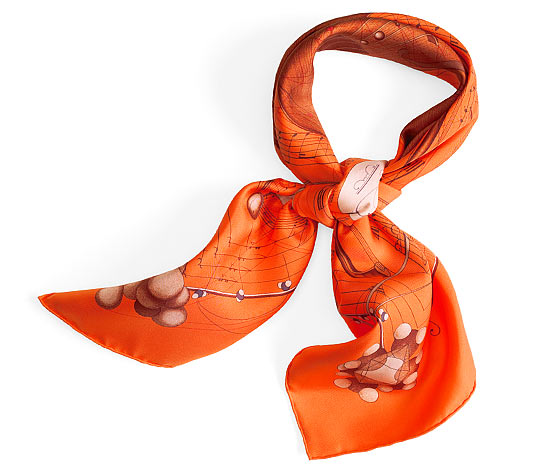
An apparent ode to music (it is widely reported that Bach's inspiration for his music was drawn from the harmony of the universe), this scarf pays tribute to the popular belief that music and mathematics share both grace and harmony - hence the mathematical symbols - the water's molecular structure (represented by the circles) and the representation of the Pythagorean theory. The focal point of the design is the rendition of the exquisite "Viola di Medici", produced by Antonio Stradivari in 1690. The exquisite beauty of this violin (captured vividly and with accuracy on this scarf) makes all those beliefs very credible !
The interesting aspect is that when the scarf is knotted, the enchanting effect is somewhat lost, as the scarf does not convey the same emotion, mainly due to its many lines suggestive of geometric shapes, including the spheres in every corner, which carries one's imagination to a certain intergalactic journey (or perhaps the mollecules inside the human body). While theoretically linked by way of a certain belief that music lifts spirits to heaven, the two concepts - violin and intergalactic journey - do not seem to coexist harmoniously on a scarf, especially when worn.
This year, Hermes has released a limited edition scarf with identical design but under a different name - Tribute to Carnegie Hall - and available exclusively in the Madison Avenue boutique. The colour ranges for the 2009 edition are violet and orange only !
Labels:
carré,
Hermès,
la musique des spheres,
silk,
twill,
zoe pauwels
Saturday, December 13, 2008
Collection SS2000: Chaque Rencontre Est Unique
I came across this design from 2000 and was captivated instantly by its beauty, simplicity, exquisite details, symbolism and its ability to capture - and express - the individuality of the Japanese spirit.
"Every Meeting is Unique" is a tribute to the people, animals and to a certain extent, the things that we come across. The upper and lower sides of the scarf depict a meeting, possibly between two individuals, possibly between four. Of equal interest are the pairs of cranes, symbolic of Japan, that are united through a magic dance and whose shapes (another allusion to the Japanese art of shadow theatre) are graciously reflected opposite them.
The composition is classically "solar", with the focal point drawn in the middle of the scarf from which emanate towards the edges of the scarf, like sun rays, the elements of the design. This style of drawing has been the foundation of the original Hermes design; the landscape, the Arabesque, have been successfully explored only in the more recent history.
I continue to be mesmerized by the beauty of this scarf, and the rich meaning its title and its design carry.
I dedicate this scarf to all those who have crossed my path in life, indeed, I dedicate this to all my friendships and also those encounters that, despite our wish, had an immediate unexpected effect on us yet which served to teach us powerful lessons for the many years to come.
Labels:
carré,
Chaque Rencontre Est Unique,
Hajime Katagiri,
Hermès,
silk,
twill
Subscribe to:
Comments (Atom)