Saturday, November 20, 2010

Collection SS2010: Brazil

Last week I spoke about embellishments, so I thought it appropriate for this post to explore teh theme fo ornaments, the many objects we make a part of our own to enhance a certain trait (such as our eyes or lips), or as a wardrobe accessory – all for the purpose of to enhancing our appearance and embellishing our look.

The focal point of this scarf is the "dress”, made exclusively of natural feathers, used by native Amazon Indians as an item of clothing.  Depicted in the each of the corners of the scarf is a matching tiara, a head crown of feathers that complete the costumes.  And speaking of costumes, these elements have been highly employed in the Rio Carnival, touted as the biggest on Earth, where countless costumes are featured annually, as a reflection of the native Indians’ cultures.

First released as part of the FW1988 collection, it was reissued in 1991, 1999, 2000, 2006 (in gavroche size, depicted above) and again in 2009.  Of interest is the reissue of this design as a detail of the original (depicted below), in 2001 and again in 2010 (in the gavroche and 140cm silk mousseline sizes).

This scarf ties beautifully and invites the admirer to discover its story and its history.

Saturday, November 13, 2010

Flacons

In a discussion with a friend recently, I recalled my childhood's favourite pastime of collecting things - stamps, little metal cars, even empty beer cans (after the fall of the Iron Courtain, when the market had been flooded with Western beers of sorts and the aluminum cans were an all-time novelty).   Over time, the collections reflected newer interests of mine: airplane models, Italian silk ties,  writing instruments; such collections took a life on their own, got wings and reached new heights, before my interests shifted onto objects that - perhaps - held a greater value in my eyes.  Thus I began collecting other objects that will undoubtedly form a permanent presence in my life: books.  Since times immemorial (ok, I'm exaggerating), I remember my interest in reading - since I couldn't travel (travelling abroad was a luxury reserved to a select few people of privilege), I have sought refuge in the stories, adventures and dreams captured within book covers - themselves embellished with vivid pictures, depicting glimpses of the lands within, other more "mature", leather-bound and with discreet decorations of floral or geometric patterns.  My dream, in fact, is to own a great library where friends can find both sanctuary and inspiration.  Thus have some objects stayed with me for a long time, and it's very likely they will continue to enrich my existance in countless ways.

To reflect the true spirit of collections, "Flacons" ("containers") features a series of bottles used by apothecaries to hold and offer medicinal potions or beauty liquids.  Each one, in its creation, became a piece of art in itself, becoming a testament to the artists' creativity and craftsmanship.  A classic scarf that ties beautifully (while the scarf displays wonderfully, it is the knot that captures the essence of the container's beauty and mistery).

Saturday, November 6, 2010

En attendant 2011 ......Collection FW2008: La Rosée

I recently had the good fortune of seeing samples of the new 2011 Spring/Summer collection and I must confess, I felt quite disappointed by the designs.  As word has it, the collection is a tribute to the "artisans", the talented creators in the service of Hermes behind the art so dear to our hearts.  I also like to think that the "year of the artisan" is an homage to all creators, of all walks of life, whose passions for the objects they give shape to, coupled with their relentless search for excellence, infuse life into their creations, which, in their turn, take our breaths away. So while the designs are short of spectacular, they serve as a reminder of the struggle that artisans (designers, craftspeople, experts and specialists alike) overcome in their creative process, sometimes with mixed results; yet, such results are necessary for the creators' self-improvement.  And let's not lose sight of the creativity that nevertheless went into these designs, the constant commitment to impeccable creations, and the paramount effort dedicated to the vision.  I anticipate to reveal some of these designs (starting with the one that marked me the most, entitled "Reve du corail" - "Coral Dream") shortly.  

Before I embark on that journey, however, two more scarf designs came to mind, to reflect the recent experiences I had.  Today's post will focus on the rose, the magnificent flower known the world over, whose beauty mesmerizes us: the richness of the petals enchants us, the breathtaking colours fascinate us and each flower's distinct perfume intrigues us.  The rose has been equally portrayed as a symbol of life's (early) struggles, allegorically used to describe both the obstacles (thorns)-filled paths one has to follow to reach an end, and one's attempts to preserve the most valuable possessions.

Yet, for all the richness of our language, It is very very difficult to write about flowers.  I mean, how could we?  Just as many of the natural hues can never be reproduced on fabrics, words fail to describe the intensity of our feelings when we come across a spectacular flower, when we acknowledge the long process the plant has to undergo to bloom, and when we offer (or receive) a rose as a symbol of love, attention and affection.  Moreover, every flower's uniqueness represents a challenge for anyone attempting to describe flowers in general.  It is only through multiple writings, collectively forming a floral mosaic, that we begin to appreciate the flowers (and roses, in particular) for what they are.
As I'm about to head to a flower market, as I normally do early on Saturday mornings to pick up a fresh bouquet in season, I was reflecting on the presence - omnipresence - of flowers in our daily lives.  They accompany every major event that punctuates our existence, from birth to marriage to mourning.  More, when we talk of them, the conversation of flowers is rich of symbolism (the mysterious orchid, the virgin white lily, the passionate red rose, the immaculate and delicate snowdrops).  Perhaps it's our propensity to use flowers as a way to express our amazement, doubts, anxieties and passions.  Flowers whether budding, in bloom or wilting on their way to obsolescence, be they simple or sophisticated, delicate or triumphant - certainly managed to captivate us and capture our imagination since times immemorial (think only of the Dutch painters, whose masterpieces, depicting flower arrangements, or whose creations, through the use of flowers or "petal painting technique", continue to fascinate us to this day).   
The rose, illustrated on this canvas, is majestic - rich with petals, fresh when sprinkled with the morning dew, the depictions give the impressions of the flowers being alive, and we find ourselves tempted to reach over to caress them.  The dark roses in the lower right hand corner (violet?  black?) are not only breathtaking, but also intended to balance out the roses from opposite corner, so when the scarf it knotted, it intrigues the wearer and the admirer alike.  The images (particularly the loose petals) equally appeal to our olfactory sense: the scarf left me wondering what those roses smelled like, leaving me longing for savouring the rose fragrance in all its beauty.  This design was first launched in 1960 and reissued, starting in late nineties, early 2000s and again in late 2000, in silk twill, cashmere/silk and mousseline.

The design is an absolute proven classic.  The "bouquet" of colours will instill a traditional feel or - alternatively - a sense of adventure; for instance, the two colour combinations featured above are illustrations of a more traditional design (the first, with its hues of light blue) and of the more daring kind (the second, due to the matching of unconventional, yet beatifully harmonious, colours).

Saturday, October 30, 2010

L'ART D'ECRIRE

It's certainly been a long time since a scarf design managed to take my breath away - until tonight, when, in search of inspiration for something spectacularly different, I came across "L'Art d'écrire" ("the art of writing").


Having an absolute passion for writing instruments, this design resonated with me instantly.  The irony is that while I haven't been gifted with a beautiful penmanship, I am the first to admire a beautiful writing style.  Or, perhaps, it is exactly because I don't possess it that I admire it whenever I see it.  Or, better yet, because the art is so rare to come by, it's all the more precious.  Either way, I feel a certain harmony and pure beauty exuding from the artistically crafted letters, their shapes, winding on the paper like paths through the valley conjured by mountains, enchanting the eye as do the sounds of violin in the intimacy of a private room.  The path each letter draws is an invitation to discovery, to adventure, to beauty and to higher learning.  Their music render a symphony to those inclined and willing to listen.


Released in 1957 and reissued in 1999 in moussline and in 2005 in silk, this scarf is as contemporary today as it was half a century ago, particularly in pastel colours.  Its timelessness is likely due to the art of writing, which continues to fascinate people all over the world, who embrace it actively and instill its sense of beauty in the future generations. 

Saturday, October 23, 2010

Collection FW2010: Soirée de Gala

This week I continued my exploration of the City of London, and while the museums were great and the food tasty, the epitome of the culture I found at the Royal Opera House, at Covent Garden.  It was by chance that I had such an incredible experience.  Not only have I been lucky to come across the tickets, but also, for the big opera aficionado that I am, I got to see Rigoletto, one of my all-time favourite operas.  Needless to say, the experience was truly unforgettable, and not as much for the venue where the artists performed, as for the staging.  The sheer number of singers provided both an insight into what the court of an Italian Duke would have likely looked like, and a depth to the performance (voice-wise) unmatched in many a performance.

"Soirée de Gala" ("Gala Party") is a rendition of the scene (read: commotion) in front of the (old) Opera House in Paris (Opera Garnier) with an arriving patron descending from a coach, other greeting and exchanging pleasantries on the steps of the imposing building, richly ornate to match the grandeur of the upcoming spectacle.

Issued originally in 1950, this design was recently relaunched in 2006 and, more recently, as part of the Fall/Winter 2010 collection.  Jean-Louis Clerc, the artist behind this rendition, created other designs for the Maison, such as Armenonville (of 1961) where his "signature" style is obvious.  

The scene leaves you anticipating excitedly the lifting of the curtain, just as the scarf, wonderfully wrapped around someone's neck and revealing - intriguingly- only brief snippets of the performance leaves you ever so mesmerized...

For added excitement, I'm attaching below a picture featured by Hermes in its fashion magazine.  The scarf depicted in the picture is of cashmere, with fringes - a beautiful scarf that can be decidedly unisex with the right accessories (such as a pair of masculine boots, or possibly a "rough"-looking beard).

Saturday, October 16, 2010

Collection SS2003: Trésors du Nil

Having just arrived in London,  I embarked, on short order, on a voyage of discovery inside the British Museum, not least to experience Norman Foster's creation in the Great Court, the glass-enclosed ceiling covering the old garden, now transformed in the largest square in Europe.  But the highlights continue to be the Rosetta Stone, the engraved text of which provided the key to deciphering the Egyptian hieroglyphs, as well as the other Egyptian, Asyrian and Greek artifacts (such as the Elgin marbles).

Issued in 2003, "Tresors du Nil" ("Nile Treasures") opens a fascinating window into the ancient Egyptian civilization, as we know it today from such artifacts and texts.

This scarf, just like the visit to the Museum, is spectacular not as much for what it displays, but for what it allows us to imagine.  Perhaps that is one of the most tremendous legacy such values - both cultural and philosophical - have succeeded in leaving behind.

The colour combination - particularly the crispiness of white silk's shine against the dark brown - is equally spectacular.  Although the pattern along the scarf's edge may be traditional but I'd like to think that the pattern, just like the treasures of the river Nile, are timeless.  And it's precisely because of its timelessness that this scarf can be sported by guys alike - although, if one might be concerned about the item's association with femininity, he could balance it with a pair of more rugged boots (an item distinctly masculine).

Saturday, October 9, 2010

Saturday, October 2, 2010

Saturday, September 25, 2010

Bibliothèque

The last leg of my trip was spent in Romania, the place of my birth whose name alone triggers a unique vibration for me.  For personal reasons (which I'll reserve for later posts), the trip has been full of very intense emotional experiences, and as much as I find them taxing not least because I love living and experiencing the world feelingly, I always find myself looking back with nostalgia for the place, in my heart, that is "my Romania".

I credit my own upbringing in Romania for the passion that I have been cultivating for books, in general, and for reading.  And this post is most appropriate to pay tribute to the objects in our lives that invite us to discover places and people of far-away lands without leaving the comfort of our own home.  I am definitely one of the folks who not only take refuge in the comfort of a book, but also use every opportunity to savour books published in Romanian (as an intimate part of the culture, the language is for all of us the most readily available mechanism that allows us to feel connected to our culture - and that couldn't be more true in my case).

"Bibliotèque" ("Library") depicts the treasures that we all strive to acquire in our attempt to quench the curiosity that takes hold of us from the earliest age.   

A stunning design where the pattern of select books, suggestive of covers of glorious stories, are harmoniously matched with colours that stir the viewer.  My passions for books and impeccable silk fabrics are perfectly matched in this design.

So I bid you farewell until next week, for I must hurry to shop for some new titles, which I'm only too eager to add to my own personal "biblioteque".

Saturday, September 18, 2010

Trophées de Venise


As I embark on a trip that will enable me to explore, admire and fall in love with Venice, I thought it perfectly fitting to live the excitement of experiencing the glory of "La Serenissima" ("the most serene", the name conferred onto the Republic of Venice) through the very design that Hermes chose in paying tribute to the city built in the middle of the sea.  

"Trophées de Venise" ("Trophies of Venice") is an ode to the cultural richness offered uniquely by Venice, as the focal point of this design - the four horses depicted from an angle slightly to the right of the ensemble - makes obvious.  The illustration is a direct reference to the Triumphal Quadriga, the bronze horses adorning the façade of St. Mark's basilica since the thirteen century (previously, they had crowned - appropriately - the Hippodrome of Constantinople until the city fell, during the Fourth Crusade of 1204, to the Christian armies; the Venetian troops were quick to "rescue" them by bringing them back to Venice; there was a further hiatus in their presence in St. Mark's square, thanks to Napoleon's wish to place them on the "Arc de Triomphe du Carrousel"; the originals have since been returned to Venice, where the exact replicas continue to look over St. Mark's square while the originals can be admired inside).

The corners above the horse ensemble depict further highly recognizable elements of Venice - St. Mark's basilica, with its eclectic architectural motifs, and two of the ubiquitous bridges across the lagoon canals, underneath which you recognize the gondola heads (whose iron, used to gain stability by counter-balancing the gondolier's weight, is a mini-map of Venice: the six strips called "pettini" (comb) represent the six "sestieri" (quarters); an additional long strip represents Giudecca Island; the double "S" bending represents the Grand Canal; on top is a stylized dogal horn and, under that, a lunette representing the Rialto bridge).

All around the apparent circles are illustrations of the domes found in the churches of Venice.  Finally, the two peacocks placed in the middle of the lower half of the design are a direct reference to the byzantine art, ever so present in the Venice's architectural gems.  Within the spiritual teachings of Christianity, they symbolize resurrection, renewal and immortality.

Needless to say that I'm thrilled to have the chance and opportunity to re-live the experiences I've been deriving from my readings on Venice, in real life.

Saturday, September 11, 2010

Collection FW2007: Carnets de bal


Ahead of my upcoming trip to Europe, I have been imagining the places to check out and the activities to fill my time with, and during this exercise in day-dreaming, I recalled another voyage of discovery to a place far-far away that succeeded to enchant me beyond my wildest expectations from the first moment I set foot in the airport.  If you thought of my time abroad in 2007, you guessed correctly that I was referring to Japan, a land whose people (and beauty) marked me for life and continues to inspire me to this day.

During my time there, Hermes had launched "Carnets de bal" ("Dance Cards"), a design representative of the beautiful Art Nouveau movement.  Dance cards, at their peak in the 18th century, served to remind society ladies the order of the dances they were to perform, along with the names of their partners (interestingly, mend eventually adopted them as well).  As this design illustrates, dance cards evolved to elaborate "objets d'art", highly decorative objects often ornate with precious materials (silver, gold, ivory or pearls) and jewels.

The contour of the "frame" onto which the dance cards are displayed reminds me of the Parisian "Metro" entrances of yesteryears, designed by Hector Guimard, that added even further to the metropolis' charm.

This design manages to appeal to younger and more matures audiences alike, as it maintains its unique femininity both when displayed and when knotted.  And one of my personal favourites, particularly since I associate this beautiful design with a place that I found most beloved !

Saturday, September 4, 2010

Collection FW2007: Bolduc au Carré

A model from the FW2007, "Bolduc au Carré" ("Ribbon Squared") is simply charming.  The scarf design pays tribute to one of the subtle yet iconic elements of the Maison, the thin ribbon used to wrap the gift boxes.


The design illustrates a pattern of different coloured-ribbons, harmoniously weaved into a "cloth".  It's an impactful design, perhaps a little mature in the colours that I featured, but definitely young in some more vibrant colours, as issued by the House since 2007, in both traditional silk scarves and cashmere/silk shawls.  A truly timeless design ! 

Saturday, August 28, 2010

Collection FW2007: Projets Carrés


One of the more thought-provoking designs of the recent past is "Projets Carrés" ("Projects Square(d)"), launched as part of the FW 2008 Collection (my inspiration came from some ads I noticed posted around downtown Toronto, while riding my bike (I almost fell off my bike in fact seeing those pictures).

The composition is deceptively simple, featuring elements of the horse harness, most presented if not in pairs, at least symmetrically - stirrups, bits, straps - while select elements are on their own, such as a comb and (possibly a hip) strap).  Yet the apparent "disorder" in which they are presented triggers a feeling of abundance.  This richness is further enhanced by the alternation of the materials these objects are made of - leather and metal - two elements (one organic, one inorganic) that create a certain tension between them (the leather pieces make me think of objects of fetish, which, in combination with the whips, are meant to trigger the viewer's curiosity, sense of intrigue and overall admiration for the design).

What I particularly admire about this scarf are two aspects: one has to do with the very vibrant colour combinations (depicted is the anis green/olive green/brown/gray/copper orange; another design I recently remarked featured a white background against which the same elements are rendered in bright - almost "Valentino" - red).  The second aspect has to do with the depiction of the border on the scarf: by way of "inserting" faint white "spots" within the solid border, the eye detects a textured fabric framing the objects captured inside.  So powerful is the impression, in fact, that I, along with everyone I knew, felt tempted to touch it to believe my eyes (to the touch, that portion of the silk feels the same as the rest of the scarf).  The impression of textured canvas serves as a great base onto which the depicted objects appear as if they are three dimensional (sensation triggered in part by the manner in which the strap, in the lower part of the composition, comes outside the border ever so delicately).

I get many questions about who could wear a certain model - or rather, what does the model best evoke.  I'm happy to suggest that this pattern is very young, and even edgy.  Indeed, a great design, one that appears equally beautiful when the scarf is knotted as when it is displayed.  So wear it with confidence and you'll appear magnificent !  I, for one, have loved this scarf ever since it came out for the design is equally stirring and intriguing.

Saturday, August 21, 2010

Collection FW2006: Touch Me

This is a very interesting scarf, not only for the effect it has on those who seek its meaning, but also for the way it is built - the manner in which the effect was realized.

"Touch Me" is appropriately inviting the admirer not only to take note of what the design conveys, but also - or even more so - to reach out and feel the scarf.  The design depicts a pattern that is - indeed - fur (or at least fur-looking).  The effect is so powerful, in fact, that you'd be tempted to see what touching the scarf would feel like.

Upon closer inspection, however, you notice that what you took to look like fur is nothing but meticulous hand drawings, similar to the ones we "tried" our hands at, when we discovered the wonderous pencils (or crayons). 

I'm not sure what this scarf would look like around someone's neck - but I can only fancy it would look both elegant and intriguing, and awfully warm!

Saturday, August 14, 2010

Collection FW2010: La Vie du Grand Nord

La vie du grand nord ("Life at the Great North") is a tribute to the spectacular life, its struggle and its beauty against immaculate surroundings, at the Pole. 

The scarf has been imagined as independent scenes surrounded by "naive" drawings of iconic mamals of the area - reindeer (also known as the caribou in North America), whales, walruses and seals - that bring the story to a harmonious close (this design reminds me of the Pani la Shar Pawnee design, similarly constructed).  The inner square depicts, as the focal point, a creation whose four white arms, like four tree trunks, spread in the four "corners" of the universe - perhaps a hyperbole for the source of life - each ending with a rich tree root.

Aline Honore designed this scarf and Hermes launched in 2004/2005; the image depicted below is part of the reissued series (belonging to the Winter 2010 collection), in different colour combinations (the one below is absolutely stunning, the kind of design that takes your breath away).

When knotted, the scarf does not appear as gloriously as when displayed, for the leaf motif, depicted in every corner, is a very abstract element that prominently displays when the scarf is knotted, thereby taking away from the glimpses of true North life that the scarf features in the middle - and which, in fact, not only make for the beauty of it, but also acts as the element of the design that gave the scarf its name; yet, I ancitipate that this will become a very admired and beloved scarf, particularly for those fashion-sensible ladies (and sophisticated gents?) who recognize that true success depends only on taking chances - in fashion as in life.

Saturday, August 7, 2010

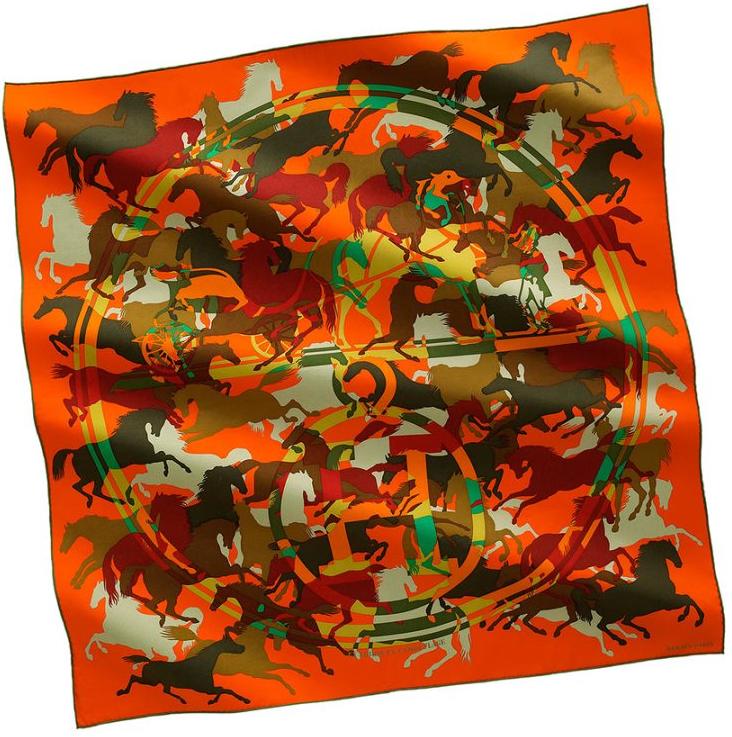
Collection FW2010: Ex-Libris en Camouflage

"Ex-libris" is a Latin phrase that means "from the books" (often used to indicate ownership of the book).  This scarf pays tribute to the very symbol of the Maison, the carriage, the splendid horse and the groom.  Legend has it that Emile Hermes chose this design as his personal "signature stamp" on every book he owned, when he decided to bind each one in the same leather cover.


The design proved so successful and influential, it proved the inspiration behind the House's emblem because it best captures - and encompasses - the essence (and raison d'etre) of Hermes.  


The camouflage, artfully obtained by countless silhouettes of galloping horses, adds a contemporary feel to this otherwise timeless symbol.  Once I recognized the overall pattern, I laid my eyes on the focal point of this scarf, the "H", above which the unmistakable "duc" (the elegant calash), the groom in livery attending to the horse, and the noble horse itself, stationary, dreaming of mad careerings...


I find this particular pattern sublime, for its vibrant, unconventional colours infuse tremendous energy into the scarf, rendering it not only contemporary, but uniquely timeless.  As only select patterns succeed, it displays as beautifully as it appears knotted.  This scarf is a definite "hit".
The shot below, featuring this pattern, was chosen to represent this season's collection.  Wonderfully conceived and skillfully depicting the scarf, this add equally intrigues and mesmerizes the admirer.


Back in May 2010, Martha Stewart decided to invite Hermes' North American President, Bob Chavez to her show (accompanied by scarf specialist Susie diCecco, the House's aesthete in charge of artistic displays of scarves).  Martha, in her characteristic style boasting about how many scarves she bought as well as received over the years, was wearing this scarf in brown, appearing to have received it as a gift right before the show.  Needless to say, it was impactful yet discreet (and utterly elegant) - the perfect accessory.


Saturday, July 31, 2010

Collection FW2010: Cheval de Légende

This design inevitably carries us back to our childhood and the wonderful world and heros' adventures we first heard from our parents, then read ourselves as our curiosity and thirst for discoveries made us come across the books ourselves.

"Cheval de légende" ("Legendary Horse") pays tribute to Pegasus, the horse brought to life by the Greek mythology.  The legend recounts how the Greek hero Perseus cut the Gorgon Medusa's head off, and from the spilling blood Pegasus, a beautiful white winged horse, sprang to life.  Ancient etymology links the name to water and springs: the so-called Hippocrene spring on Mount Helicon marked the spot where Pegasus struck a rock with his hoof.  Its waters were a source of poetic inspiration.

On Mount Olympus, the gods' home, Pegasus was entrusted with the sacred task of carrying Zeus's thunderbolts, until he was tamed by Bellerophon (with the help of Athena, the protectress of heroes, who presented him with a golden bridle).  Bellerophon, the hero charged with slaying the hybrid monster Chimaera by the Lykian king Iobates, slipped the bridle around Pegasus's neck while the horse was drinking, and climbed onto his back.  Thanks to Athena's intervention, Bellerophon was able to slay the Chimaera.  After Bellerophon's death, Pegasus rejoined the gods, and eventually became a constellation.

The reference to the constellation (named Pegasus) is wittily depicted in the design by way of the tiny dots, each sparkling with a magic light, that together depict the front part of a horse about to take off.  As with many other designs, the horse brings so much energy to the scarf and instills in it the admiration that such a noble animal commands.  The overall depiction is sadly lost when the scarf is tied - another testament to how this scarf manages to convey different feelings and moods, depending on how it's displayed.  The apparent "rope", also made up of little stars, adds the element of border (as with a painting) to the design, and renders the scarf more interesting when knotted.  Overall, a very contemporary design best admired for its non-traditional colours (the fuchsia and the green particularly stand out for their unusual hues).

It is also reminding me of the "pearls" design featured as part of the spring/summer collection - which I featured last week.

Meanwhile, so confident was Hermes in the success of this design, that it decided to expriment with it as the dial of the Arceau model.

Saturday, July 24, 2010

Collection SS2010: Kelly en Perles

The fascination with this scarf stems from two classics of our times: Princess Grace Kelly, whose rafinement and indeed grace has inspired countless artists to dedicate their creations to her and even name such creations after her, and the timeless pearls, themselves a symbol of immaculate purity, of valuable possessions and most importantly of treasured objects whose beauty is meant only to enhance the beauty of the wearer. 

"Kelly en perles" (Kelly in pearls") is an exploration into the fantastic, a reinterpretation of classic aesthetic into contemporary tastes and standards.  The actual composition, suggestive of colourful glass beads in the style of artists from Cameroon, confers upon the scarf a very tangible sensation - thanks to Hermes' fine-tuned and impeccable techniques of rendering 3-D objects into 2-D spaces.  The focal point of this scarf is the timeless Kelly bag, itself formed by countless beads in a most realistic depiction.

The actual scarf is not necessarily at the top of my preference in terms of design (neither displayed fully, nor knotted), but it is most memorable for the pattern, reminiscent of the beaded coin purses so popular in the country side during my childhood in Eastern Europe, little treasures that continue to make me smile, even after so many years of having been burried in the back of my memory's "drawers".  So in this sense, I perceive this scarf as triggering utterly "happy" memories for me.

Saturday, July 17, 2010

Collection FW2010: The Rhythm of China

Back in early January, I featured a design, called "Hermès en voyage", inspired by artist Ding Yi's work.  This fall/winter design "Rhythms of China" is a very close interpretation of the artist's creations (one in particular springs to mind, namely 2003's "Appearance of crosses - 12" for instance).  On closer inspection, the individual "pixels" are in fact delicate snow flake-like stars, forming a tight web of equal harmony and vibrant energy.  When knotted, the dynamism of the pattern becomes not only visible, but also much more impactful.  A very contemporary scarf suited for young stylish and mature sophisticated ladies alike.  

An interesting detail about this scarf: it was launched in China by the Maison several years ago, and featured in an exhibit organized in September 2007 in Shanghai at the Shanghai Art Museum to mark 70 years from the launch of the first scarf, and 10 years of the Maison catering to the Chinese clientèle through local boutiques.

Regardless of when this design was released, this scarf is thoroughly impressive !

Saturday, July 10, 2010

Collection FW2010: La Charmante aux Animaux

This scarf draws its inspiration from the One Thousand and One Nights (known in English as the "Arabian Nights" from its first English language edition in 1706, which rendered the title as "The Arabian Nights' Entertainment").  In the centre of the scarf, seated next to the Persian King (Sultan), is none other than his beautiful new bride, Sheherazade, who mesmerizes him with story upon story (which she begins every night, but does not finish until the next night). 

"La charmante aux animaux" ("the Animal Charmer") picks on one such story, telling of the animals who roam freely on this earth.  As always with Annie Faivre, whose nickname is "little monkey", she chose to include the representation of a monkey in the detail of this scarf.

What I find interesting is that the design is very baroque in its richness, and the organic pattern that provides the background for the design; because of this, the scarf has a rather traditional feel to it (as opposed to lighter and asymmetrical motifs that would define it as more modern) and so I anticipate this scarf to be more appealing to a more matude crowd, despite the timeless theme.

Saturday, July 3, 2010

Collection SS2008: Astrologie


This design has been among the most popular designs that Hermès has produced.  With this post I am taking a detour from our current collection so as to feature something spectacular and mesmerizing that's worth of at least one post.

Since its launch in 1963, "Astrologie" ("Astrology") has been reissued at least 17 times over the years.  Its success has been so tremendous, that many recognizable stars have opted to sport a scarf depicting the Astrology design on the cover of magazines and making newspaper headlines (see below Jackie Kennedy, before she became "Mrs. Onassis", as well as Oprah on the cover of her magazine).

Conceptually simple, the design is spectacularly embellished to regal standards of beauty and harmony.   

Saturday, June 26, 2010

Collection SS2010: Chevaux Qataris

An artist long admired for his intimate knowledge and unique ability to depict horses, bulls and (hunting) dogs (and a personal favourite of mine as well), Hubert de Watrigant has enchanted me again with yet another design. “Les Chavaux Qataris” (“the Qatar Horses”) is a tribute to the majestic breed of the Arabian Horse, whose distinctive head shape and high tail carriage commend so much respect and love from horse lovers and connoisseurs alike.
What you come to recognize is the particular dynamism of this design, due to the depiction of the horses as running freely across the folds of the scarf.

The renditions in the corners make me think of Native Indian artifacts - which may or may not be the case, although I did recognize, in the patterns along the edges, typical Argentinian belt patterns.

Perhaps designed as such on purpose, the horses at the bottom of the design are facing inward, whereas those in the upper corners are facing out - so as perhaps to inspire the admirers to look for more horses than the two heads seen in the corners, when the scarf is tied.  I would have preferred to see all corner horses face outward, because the allure of their heads is so fantastic.  What I do appreciate is that horses are depicted as bear different colours, depending on the background hue - white and brown, in the case of the baby blue background below (which have been paired on the same side of the scarf surface - so that when the scarf is worn knotted, the front corners depict different coloured horses).  Wonderfully done !


One final aspect that contributes to the spectacular and elegant scarf: while the design has been launched first as part of the Fall/Winter collection 2008, this reissue is on the famous cashmere and silk mix.  Indeed, spectacular !

Saturday, June 19, 2010

Collection FW2006: Séquences

I recently saw a report on Eadweard J. Muybridge, a pioneer photographer whose story is as fascinating as the invention that his name is most associated with - a technique he developed to capture animal locomotion, out of a popularly-debated question of the day back in 1872: whether all four of a horse's hooves left the ground at the same time during a gallop. 

In 1877, Muybridge settled the question with a single photographic negative showing Stanford's racehorse Occident airborne in the midst of a gallop.  This negative was lost, but it survives through woodcuts made at the time.  By 1878, Muybridge had successfully photographed a horse in fast motion.

This series of photos taken in Palo Alto, California, is called "Sallie Gardner at a Gallop" or "The Horse in Motion" and shows that the hooves do all leave the ground — although not with the legs fully extended forward and back, as contemporary illustrators tended to imagine, but rather at the moment when all the hooves are tucked under the horse as it switches from "pulling" with the front legs to "pushing" with the back legs.

This scarf design is not particularly beautiful, but memorable for the tribute it pays to a discovery of our modern age.  When knotted, the scarf appears quite traditional in both colours and pattern.  The white background, however, renders it a classic though.

Saturday, June 12, 2010

Ex Libris Limited Edition for Liberty of London

This design is a visible departure from the usual creations of Hermes in that the "canvas" is no longer "clear"; instead, it features a rather heavily - albeit pastel and hence more mutedly so - floral pattern.  The Maison used one of its previous patterns (hugely successful, the "Ex Libris") to print it on the signature busy floral pattern of Liberty of London.
Launched under the banner of "Hermes pops up at Liberty", this scarf design, along with a similas one in fuchsia and pale green, proved highly popular and hence sought-after.

Saturday, June 5, 2010

Collection FW2010: Cent Plis de Miao

I haven't felt so much enthusiasm admiring the Maison's designs for a while. Yet, like a fabulous find in a treasure chest - literally or figuratively - and I'm thinking here of a pair of shoes on a shelf in a tiny shop down one of those quiet streets in an upscale "quartier" (i.e. city district) – this scarf has filled my heart with excitement and joy and stimulated my imagination. So a tribute to it is very much in order.

Perhaps the design with the most promise of the Fall/Winter 2010 Collection – and one I particularly appreciate – "Cent Plis de Miao" ("A Hundred Pleats of Miao") pays tribute to the Miao culture and its nearly four million-strong people bound by it, living in China (the Miao people also live in Vietnam and Laos, where they’re called “Hmong”).

The dress depicted in this design is highly symbolic of the Miao culture and an essential element of it, whose name means “raw rice” – the dress is often mentioned in songs and folk tales, thereby becoming an integral and defining element of the culture. The fabrics are pleated, a technique believed to be inspired from (and reflective of) the mushroom gills. The finer the pleats, the higher the value of the dress.

Of particular interest is the creative craft of rendering the colours on the dress: the blue hues are obtained from a natural indigo pigment where the fabric, previously marked with wax to protect the areas (of the design) desired to appear white, is allowed to soak in the indigo dye. Once the desired hue is obtained, the fabric is remove, allowed to dry, then heated – both to remove the wax and finally to reveal the white patterns. The rest of the colours are embroidered by hand (a fantastic collection, consisting of similar dresses with no less than a thousand pleats is on display at the Musée du Quai Branly in Paris).

The darling of the aficionados and one of the most prolific designers in the service of Hermès, Aline Honoré has delighted us yet again with a design inspired from far-away lands, equally fascinating and mysterious. She chose to depict the dress in all its splendour, spread across a surface suggestive of another type of fabric design that the Miao women choose to wear tied around their legs, whose patterns of squares and lines are also representative of their culture. Reminiscent of the Brazil design of the previous season’s collection in the dress display, the similarities between the two designs stop here. The background is simple so as to allow the dress to shine. A truly beautiful – artistic, creative, sensible display worth the glory the Hermes silk twill brings to it.