Showing posts with label Benoit Pierre Emery. Show all posts

Saturday, August 7, 2010

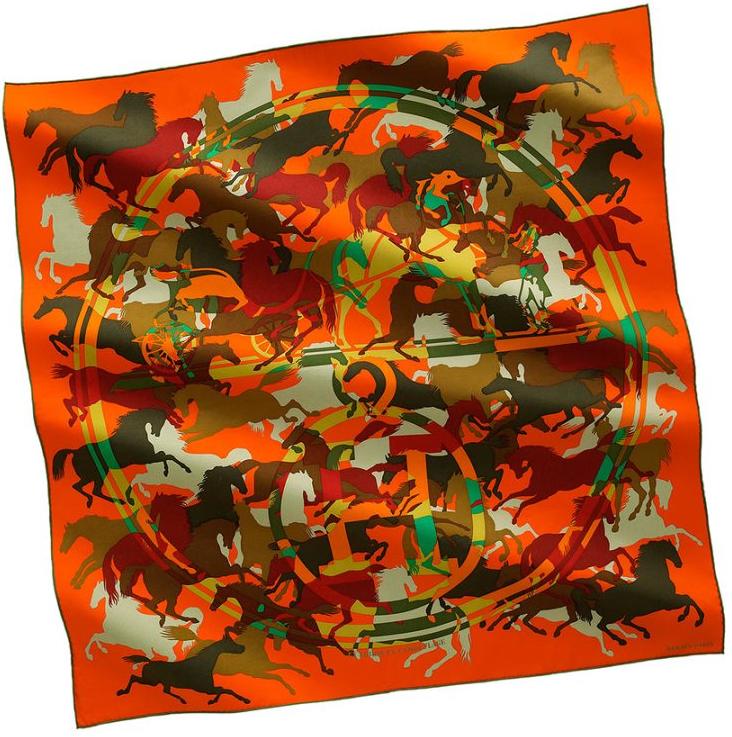
Collection FW2010: Ex-Libris en Camouflage

"Ex-libris" is a Latin phrase that means "from the books" (often used to indicate ownership of the book).  This scarf pays tribute to the very symbol of the Maison, the carriage, the splendid horse and the groom.  Legend has it that Emile Hermes chose this design as his personal "signature stamp" on every book he owned, when he decided to bind each one in the same leather cover.


The design proved so successful and influential, it proved the inspiration behind the House's emblem because it best captures - and encompasses - the essence (and raison d'etre) of Hermes.  


The camouflage, artfully obtained by countless silhouettes of galloping horses, adds a contemporary feel to this otherwise timeless symbol.  Once I recognized the overall pattern, I laid my eyes on the focal point of this scarf, the "H", above which the unmistakable "duc" (the elegant calash), the groom in livery attending to the horse, and the noble horse itself, stationary, dreaming of mad careerings...


I find this particular pattern sublime, for its vibrant, unconventional colours infuse tremendous energy into the scarf, rendering it not only contemporary, but uniquely timeless.  As only select patterns succeed, it displays as beautifully as it appears knotted.  This scarf is a definite "hit".
The shot below, featuring this pattern, was chosen to represent this season's collection.  Wonderfully conceived and skillfully depicting the scarf, this add equally intrigues and mesmerizes the admirer.


Back in May 2010, Martha Stewart decided to invite Hermes' North American President, Bob Chavez to her show (accompanied by scarf specialist Susie diCecco, the House's aesthete in charge of artistic displays of scarves).  Martha, in her characteristic style boasting about how many scarves she bought as well as received over the years, was wearing this scarf in brown, appearing to have received it as a gift right before the show.  Needless to say, it was impactful yet discreet (and utterly elegant) - the perfect accessory.


Saturday, July 31, 2010

Collection FW2010: Cheval de Légende

This design inevitably carries us back to our childhood and the wonderful world and heros' adventures we first heard from our parents, then read ourselves as our curiosity and thirst for discoveries made us come across the books ourselves.

"Cheval de légende" ("Legendary Horse") pays tribute to Pegasus, the horse brought to life by the Greek mythology.  The legend recounts how the Greek hero Perseus cut the Gorgon Medusa's head off, and from the spilling blood Pegasus, a beautiful white winged horse, sprang to life.  Ancient etymology links the name to water and springs: the so-called Hippocrene spring on Mount Helicon marked the spot where Pegasus struck a rock with his hoof.  Its waters were a source of poetic inspiration.

On Mount Olympus, the gods' home, Pegasus was entrusted with the sacred task of carrying Zeus's thunderbolts, until he was tamed by Bellerophon (with the help of Athena, the protectress of heroes, who presented him with a golden bridle).  Bellerophon, the hero charged with slaying the hybrid monster Chimaera by the Lykian king Iobates, slipped the bridle around Pegasus's neck while the horse was drinking, and climbed onto his back.  Thanks to Athena's intervention, Bellerophon was able to slay the Chimaera.  After Bellerophon's death, Pegasus rejoined the gods, and eventually became a constellation.

The reference to the constellation (named Pegasus) is wittily depicted in the design by way of the tiny dots, each sparkling with a magic light, that together depict the front part of a horse about to take off.  As with many other designs, the horse brings so much energy to the scarf and instills in it the admiration that such a noble animal commands.  The overall depiction is sadly lost when the scarf is tied - another testament to how this scarf manages to convey different feelings and moods, depending on how it's displayed.  The apparent "rope", also made up of little stars, adds the element of border (as with a painting) to the design, and renders the scarf more interesting when knotted.  Overall, a very contemporary design best admired for its non-traditional colours (the fuchsia and the green particularly stand out for their unusual hues).

It is also reminding me of the "pearls" design featured as part of the spring/summer collection - which I featured last week.

Meanwhile, so confident was Hermes in the success of this design, that it decided to expriment with it as the dial of the Arceau model.

Saturday, May 2, 2009

Collection SS2009: Hermès Sellier


The impact of this design comes from the symmetry of its pattern - symbolic of the French gardens, to which this scarf pays tribute. French gardens ("jardins a la francaise") are based, as their defining characteristic, on symmetry and the principle of imposing order over nature. Designed to evoque harmony and order - the ideals of the Rennaissance - and to recall the virtues of the Antiquity - the standard of
professional accomplishment and source of profound inspiration, the French gardens have reached their apogy in the 17th century under France's Louis XIV, the Sun King, with the construction of the Gardens of Versailles by the royal lanscape architect, Andre le Notre.


The actual inspiration for this design came, according to Hermes, from the secret miniature gardens atop the Hermes boutique on rue du Faubourg St.-Honore, accessible to a fortunate few.


"Sellier" means "saddle maker" and, referencing the House's beginnings, has become an integral part of the official name (and legal name: "Hermes Sellier SA", illustrated on the scarf in the 1930s font). Created by Benoit Pierre-Emery and issued as part of the Spring/Summer 2009 collection, this scarf ties interestingly, particularly for the anthracite grey with contrasting
orange hem.

Saturday, February 28, 2009

Collection FW2007: Faubourg by Night

This design has been issued in 2007/2008 and remains one of Hermes' most impactful abstract designs. It depicts the Maison's iconic building at 24, Faubourg as perceived through a kaleidoscope.

The kaleidoscope, invented around 1816 by the Scottish physicist, mathematician, astronomer, inventor and writer Sir David Brewster, is a tube of mirrors containing loose coloured beads, pebbles or shards, which produces, when turned, varying colours and patterns; because of the mirrors, the reflection of such arbitrary designs produces beautiful symmetrical patterns, something that I used to cherish as my secret treasure whenever my grandparents would buy me one, typically when we were vacationing on the Black Sea (the name kaleidoscope derives from the Greek "kalos" (beautiful), "eidos" (shape) and "scopeo" (to look at, to examine) - hence it would be roughly translated as "looking at beautiful forms").

Faubourg by night depicts the iconic building as an elusive shape, covered under the night's dark skies, yet the image reminds us of the intrinsic beauty of this place. It even stirs our imagination and our curiosity to discover it. A truly gorgeous design the ties beautifully and is guaranteed to elicit the admiration of any audience.

Saturday, September 27, 2008

Collection SS2008: Mosaique au 24


I love this design, and yet I find it difficult to envision it worn regularly as a scarf - hence my hesitation to acquire one. But the mosaic display carries me back to the Roman days, and the exquisite art resulting from laying tiny pieces of rock or crystal displaying the craftsmen's both vision and skills (and patience). What appealed to me in particular was the illustrated "unevenness" of the pattern in this scarf, reminding us that laying mosaic tiles is a true form of art. Finally, the design "dissipates" towards the edges, a clear indication of the passing of even the greatest of civilizations. The introduction of this design has coincided with the re-opening of Hermes' flagship boutique at 24, rue du Foubourg St.-Honoré ("24 FSH" for short), following the renovations of the premises. It was then incorporated in the 2008 spring/summer collection.